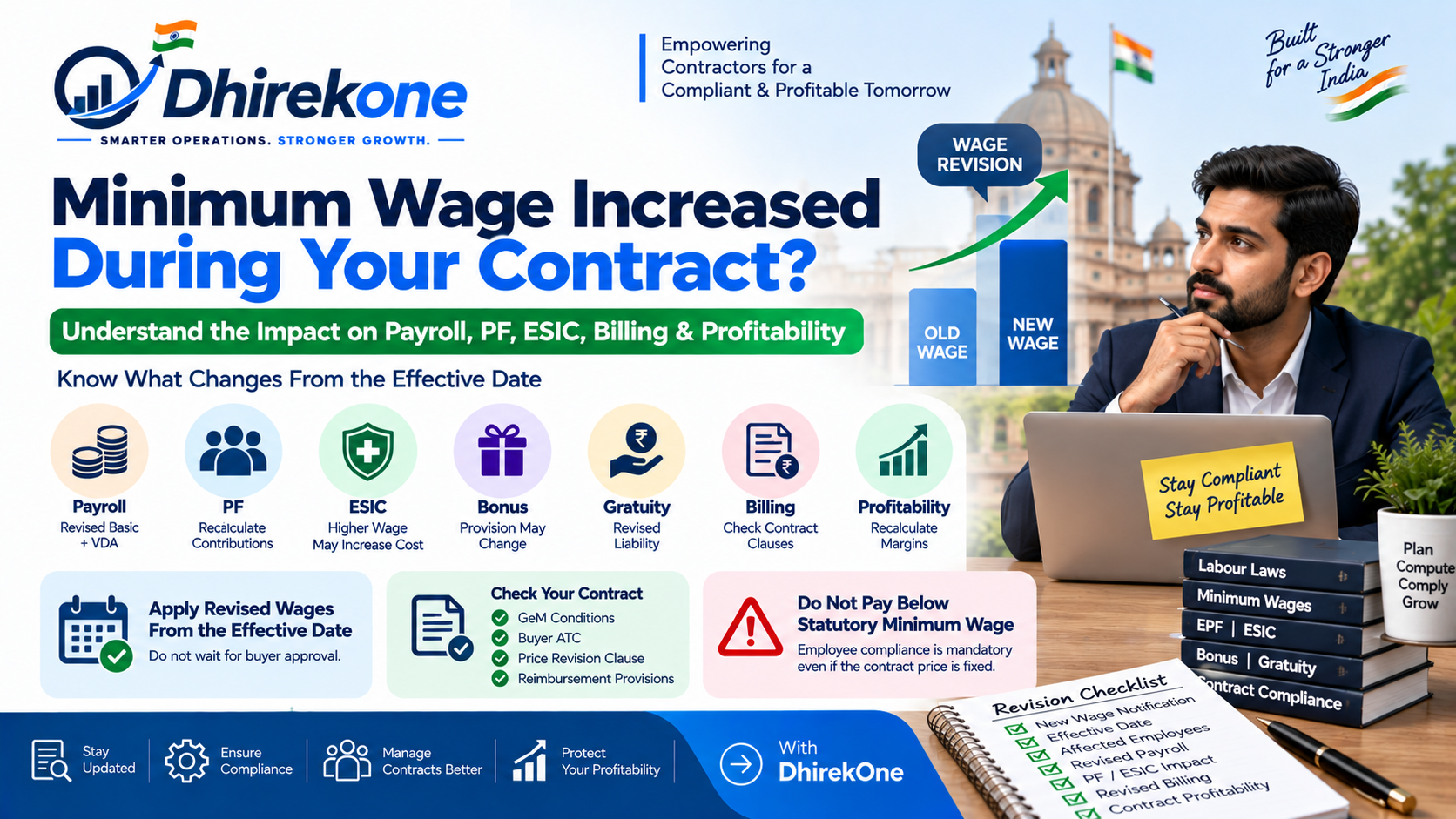

INTRODUCTION
A minimum-wage revision during an ongoing Government manpower contract creates two different questions:
- What wage must the contractor pay the employees?
and
- Can the contractor recover the additional cost from the Government buyer?
These are not the same issue.
If the applicable statutory minimum wage increases, the contractor must ensure that employees receive at least the legally applicable wage.
However, reimbursement of the additional contract cost depends on the commercial terms of the tender and contract.
Before raising a wage-escalation claim, review:
- GeM bid conditions
- Service-specific terms
- Buyer Added Terms and Conditions
- Price variation clause
- Statutory variation clause
- Minimum wage revision clause
- VDA reimbursement clause
- Contract amendment provisions
- Billing structure
- Corrigenda
This guide explains how manpower contractors should evaluate and prepare a wage-escalation claim.
Is Wage Escalation Automatically Payable by the Government Buyer?
No.
A statutory increase in minimum wages does not automatically mean that every Government buyer must increase the contract price.
The contractor's right to reimbursement depends on the contract.
A tender may:
- expressly allow statutory wage escalation,
- prescribe a formula for revision,
- allow reimbursement only for specified components,
- require prior approval,
- require documentary evidence,
- exclude certain price revisions,
- or place some commercial risk on the service provider.
Therefore, never assume:
“Minimum wage increased, so buyer must automatically pay the difference.”
Read the awarded contract first.
Employee Compliance ≠ Buyer Reimbursement
The contractor may have a legal obligation to pay the revised wage even where reimbursement from the buyer is disputed.
Therefore:
Employee Wage Obligation
and
Commercial Recovery from Buyer
must be analysed separately.
Do not delay lawful employee wages merely because the buyer has not yet approved escalation.
When Can a Wage Escalation Claim Be Stronger?
A contractor's claim is generally stronger where the contract expressly contains wording such as:
- Statutory wage revision shall be reimbursed
- Minimum wage revision shall be payable
- VDA increase shall be reimbursed
- Price shall be revised upon Government notification
- Statutory variation shall be adjusted
- Differential wages shall be reimbursed
- Buyer shall bear increase in statutory labour cost
- Contract value shall be amended based on revised minimum wages
The exact wording matters.
A broad reference to “compliance with labour laws” does not necessarily mean that every increased cost will automatically be reimbursed.
Which Contract Documents Should You Check?
Review all of the following:
- GeM Bid Document
- GeM Contract
- Service Level Agreement
- Scope of Work
- Buyer Added Terms and Conditions
- Special Terms and Conditions
- General Terms and Conditions
- BOQ / Price Schedule
- Corrigenda
- Pre-bid clarification
- Contract amendment
- Work order
- Buyer correspondence
Do not rely only on the financial BOQ.
What Clauses Should You Search For?
Search the contract for words such as:
- Minimum Wage
- VDA
- Wage Revision
- Wage Escalation
- Statutory Variation
- Price Variation
- Revision of Rates
- Escalation
- Reimbursement
- Differential Wage
- Government Notification
- Labour Cost
- Contract Amendment
- Price Adjustment
Does a “Fixed Price Contract” Prevent Wage Escalation?
Not necessarily, but it can make recovery more difficult if there is no separate statutory-variation clause.
A fixed contract price does not normally allow the contractor to pay workers below the statutory minimum.
However, whether the contractor can recover the additional cost from the buyer depends on the contractual allocation of price risk.
Therefore:
Fixed Contract Price
does not mean
Fixed Employee Minimum Wage.
Can I Claim VDA Increase from the Buyer?
Possibly.
If the applicable minimum-wage structure contains Variable Dearness Allowance and VDA is revised during the contract, the contractor should check whether the contract provides for reimbursement or rate revision.
A strong claim file should show:
Old VDA → Revised VDA → Effective Date → Employee Count → Monthly Difference → Statutory Contribution Impact → Revised Contract Cost
Example: Wage Escalation Claim
Illustrative Example:
Employees = 50
Old Monthly Wage = ₹18,000
Revised Monthly Wage = ₹19,200
Increase per Employee = ₹1,200
Monthly Direct Wage Difference:
₹1,200 × 50 = ₹60,000
Contract Remaining Period = 8 Months
Direct Wage Escalation:
₹60,000 × 8 = ₹4,80,000
Then separately calculate any consequential impact on:
- Employer EPF
- Employer ESIC
- Bonus
- Gratuity
- Reliever wages
- Overtime
- Other wage-linked costs
The final claim may therefore be higher than the direct wage difference alone, if the contract allows those consequential components.
Can I Claim PF and ESIC Increase Also?
Potentially, if:
- the wage revision changes the statutory contribution base,
- the employee remains covered,
- the contract allows reimbursement of statutory employer costs,
- and the additional contribution is demonstrably attributable to the wage revision.
Do not automatically add all PF and ESIC differences to a buyer claim without checking the contract.
Prepare an employee-wise statutory impact sheet.
Can I Claim Bonus and Gratuity Impact?
Possibly, but only where:
- the revised wage affects the relevant statutory basis,
- the liability genuinely increases,
- and the contract permits recovery of such statutory employment costs.
These components are often more difficult to claim than the direct minimum-wage differential because the contract may define reimbursable components narrowly.
Document the calculation carefully.
What About Service Charge on the Increased Wage?
This depends entirely on the pricing model.
If the service charge is defined as:
A percentage of reimbursable manpower cost
then the rupee value may increase when the wage base increases.
If the service charge is:
A fixed amount per employee
then it may remain unchanged.
If the contract says:
“Only statutory wage difference will be reimbursed”
the contractor may not automatically be entitled to additional margin on that difference.
Read the clause exactly.
Do Not Inflate a Statutory Escalation Claim
A wage escalation claim should clearly separate:
A. Direct Wage Difference
B. Employer Statutory Difference
C. Contractually Recoverable Overheads
D. Service Charge, if contractually permitted
E. GST treatment
This makes the claim easier for the buyer to verify and reduces disputes.
What Documents Should Support the Claim?
Prepare a complete claim file containing:
- Official minimum-wage / VDA notification
- Relevant contract clause
- GeM Contract Number
- Bid Number
- Old wage rate
- Revised wage rate
- Effective date
- Employee category
- Skill category
- Zone / area
- Employee count
- Old vs new monthly cost
- PF impact
- ESIC impact
- Other statutory impact
- Payroll evidence
- Wage-bank-transfer proof
- Statutory challans
- Revised invoice calculation
- Formal escalation request
How Should the Claim Calculation Be Presented?
Use a clear table:
| Component | Old Rate | Revised Rate | Difference |
|---|---|---|---|
| Minimum Wage | ₹18,000 | ₹19,200 | ₹1,200 |
| Employer PF | ₹X | ₹Y | ₹Z |
| Employer ESIC | ₹X | ₹Y | ₹Z |
| Bonus Provision | ₹X | ₹Y | ₹Z |
| Gratuity Provision | ₹X | ₹Y | ₹Z |
| Total | ₹X | ₹Y | ₹Z |
Then multiply the monthly difference by:
Affected Employees × Applicable Months
and separately show GST where contractually applicable.
From Which Date Should Escalation Be Claimed?
Use the effective date of the statutory revision, subject to the contract.
Example:
Notification Date: 15 May
Effective Date: 1 April
If the contract permits statutory escalation from the notification's legal effective date, the claim may need to be calculated from 1 April.
Do not automatically use the date on which the buyer received your letter.
Can I Claim Arrears for Past Months?
Possibly.
A retrospective or earlier-effective-date wage notification can create employee wage arrears.
Whether those arrears are recoverable from the buyer depends on the contract.
Your claim should separately show:
Current Month Escalation
and
Prior-Period Wage Arrears
along with documentary support.
What If the Buyer Says “Rate Is Fixed, No Escalation”?
Do not respond only verbally.
Ask the buyer to identify the contractual clause under which escalation is being denied.
Then compare:
- Contract pricing clause
- Statutory variation clause
- Minimum-wage clause
- Buyer ATC
- Service conditions
- Original financial bid
- Any clarification issued before bidding
If the contractual wording is unclear, submit a formal representation explaining:
- Statutory revision
- Effective date
- Mandatory employee payment
- Contractual clause relied upon
- Financial impact
- Relief requested
What If the Buyer Does Not Reply?
Maintain written follow-up.
A practical escalation sequence can be:
Initial Request
↓
Reminder
↓
Second Reminder
↓
Final Contractual Representation
↓
Applicable Grievance / Dispute Mechanism
Use the remedy available under the actual contract.
Do not rely only on telephone discussions.
Can I Raise a Representation on GeM?
For bid-stage objections, GeM provides a representation mechanism within the period available in the bid.
For an already awarded contract, the contractor should use the contract's applicable communication, amendment, grievance and dispute-resolution mechanisms.
Bid-stage representation and post-award escalation claims are different processes.
Before Bid vs After Contract Award
Before Bidding:
If the tender contains an unclear wage-escalation clause, raise clarification or representation before quoting wherever the procurement process permits.
After Award:
If a statutory wage revision occurs, submit a documented contract-revision / reimbursement request using the awarded contract's mechanism.
Do not wait until the final invoice.
Can the Buyer Recover Wages Directly from the Contractor?
Labour compliance creates additional risk for the contractor.
Government guidance has stated that where contractors fail to pay contract workers on time or make short payment, the principal employer / buyer may be required to ensure payment and recover amounts from the contractor under the applicable framework.
Therefore, refusing to pay revised wages simply because escalation is disputed can create much greater exposure.
What If Wage Escalation Makes the Contract Loss-Making?
Recalculate the entire contract.
Use:
Revised Contract Revenue
Revised Wages
Employer PF
Employer ESIC
Bonus
Gratuity
Relievers
Operations
Finance Cost
Other Contract Costs
=
Revised Contract Contribution
If the result becomes negative, the contractor should urgently review:
- escalation entitlement,
- contract amendment,
- extension decision,
- additional deployment requests,
- working capital,
- and dispute remedies.
Example: Claim with PF and ESIC Impact
Illustrative Example Only
Employees = 100
Direct Wage Increase = ₹800 per employee
Direct Wage Difference:
₹800 × 100 = ₹80,000 per month
Additional Employer PF = ₹6,000
Additional Employer ESIC = ₹2,600
Other Admissible Statutory Difference = ₹4,000
Total Monthly Escalation:
₹80,000
- ₹6,000
- ₹2,600
- ₹4,000 = ₹92,600
Remaining Contract Period = 6 months
Potential Escalation Impact:
₹92,600 × 6 = ₹5,55,600
The actual claim must follow the contract and actual statutory calculations.
Should GST Be Added to the Escalation Claim?
Check the contract's tax treatment.
Do not automatically apply GST to the wage difference without determining:
- Revised taxable value
- Invoice structure
- GST-inclusive or exclusive pricing
- Applicable tax rate
- Contract amendment method
GeM's GTC separately addresses statutory GST variation and requires documentary evidence in applicable situations.
What If the Contract Has No Wage Escalation Clause?
This is the most difficult situation.
The contractor should:
- Continue statutory wage compliance.
- Review the complete contract for indirect price-adjustment provisions.
- Check service-specific GeM conditions.
- Write to the buyer.
- Provide the Government notification.
- Demonstrate the unavoidable statutory cost increase.
- Request amendment / reimbursement.
- Avoid assuming entitlement.
- Obtain professional contractual or legal advice where exposure is material.
A strong commercial justification does not automatically create a contractual right.
What If the Contract Expressly Says No Price Escalation?
An express no-escalation clause can significantly weaken the contractor's commercial claim.
However, it still does not ordinarily permit payment below the statutory minimum wage.
The contractor must therefore separate:
Legal obligation to employees
from
Contractual right against the buyer.
Where the financial exposure is significant, obtain contract-specific legal advice before pursuing recovery or other remedies.
Best Practice Before Bidding
Before submitting any long-term manpower bid, answer:
✅ Can minimum wages change during the contract?
✅ Can VDA change?
✅ Who bears the increase?
✅ Is statutory escalation reimbursable?
✅ Does service charge increase?
✅ Are PF / ESIC differences reimbursable?
✅ Can the contract value be amended?
✅ What documents are required?
✅ Is reimbursement retrospective?
✅ What happens during an extension period?
Never Bid Without Reading the Wage-Escalation Clause
For a 12-month or longer manpower contract, wage escalation can determine whether the contract remains profitable.
Before bidding, classify the tender into one of three models:
MODEL A Statutory wage increase reimbursed by buyer.
MODEL B Only specified statutory components reimbursed.
MODEL C Fixed rate / contractor bears escalation risk.
Your tender margin and risk provision should reflect the applicable model.
Wage Escalation Claim Workflow
New Wage Notification
↓
Confirm Applicability
↓
Confirm Effective Date
↓
Identify Affected Employees
↓
Calculate Wage Difference
↓
Recalculate Statutory Costs
↓
Check Escalation Clause
↓
Prepare Supporting Documents
↓
Notify Buyer
↓
Request Contract Amendment
↓
Submit Revised Invoice / Arrear Claim
↓
Track Approval & Payment
↓
Recalculate Contract Profitability
- Before submitting your claim:
- ✅ Applicable notification verified
- ✅ Effective date verified
- ✅ Appropriate Government verified
- ✅ Skill category verified
- ✅ Zone verified
- ✅ Contract clause identified
- ✅ Old wage documented
- ✅ New wage documented
- ✅ Employee count verified
- ✅ Wage differential calculated
- ✅ PF impact calculated
- ✅ ESIC impact calculated
- ✅ Bonus impact reviewed
- ✅ Gratuity impact reviewed
- ✅ Reliever impact reviewed
- ✅ Service charge treatment checked
- ✅ GST treatment checked
- ✅ Payroll evidence attached
- ✅ Bank wage proof attached
- ✅ Contract amendment requested
- ✅ Claim acknowledgement retained
Common Wage Escalation Claim Mistakes
- Assuming reimbursement is automatic
- Not reading the contract
- Claiming from the wrong effective date
- Submitting only the wage notification
- Not showing employee-wise calculation
- Claiming unsupported overheads
- Adding service charge without contractual basis
- Incorrect PF impact
- Incorrect ESIC impact
- Not separating arrears from future escalation
- Ignoring GST treatment
- Waiting until contract completion
- Relying only on verbal approval
- Underpaying employees until the claim is approved
- Failing to track buyer acknowledgement
Track Wage Escalation from Payroll to Billing with DhirekOne
A statutory wage revision should flow through the entire contract lifecycle:
Wage Notification → Employee Classification → Salary Revision → Payroll → PF & ESIC → Arrears → Revised Contract Cost → Buyer Claim → Billing → Receivables → Contract Profitability
DhirekOne is designed to help contractors maintain this connection.
Instead of calculating statutory revisions separately in payroll, Excel and billing files, contractors can maintain effective-dated salary evidence and compare revised manpower cost against contract revenue.
This makes it easier to understand whether a wage revision has been:
- paid to employees,
- included in statutory calculations,
- claimed from the buyer,
- billed,
- received,
- and reflected in contract profitability.
Frequently Asked Questions About Wage Escalation Claims
Q1. Can I claim a minimum-wage increase from a Government buyer? Possibly. The right to reimbursement depends on the tender and contract clauses governing statutory wage revision, price variation and reimbursement.
Q2. Is wage escalation automatically payable in Government contracts? No. Statutory employee wage compliance may be mandatory, but commercial reimbursement from the buyer depends on the contract.
Q3. Do I have to pay the revised wage before the buyer reimburses me? The contractor remains responsible for complying with applicable minimum-wage obligations toward employees even while reimbursement is pending or disputed.
Q4. Can I claim VDA revision? Possibly, if the applicable VDA revision increases statutory wages and the contract allows the resulting statutory cost to be reimbursed.
Q5. Can I claim increased PF and ESIC cost? Potentially, if the wage revision changes the contribution base and the contract permits reimbursement of those employer statutory costs.
Q6. Can I claim service charge on the wage difference? Only where the contract's pricing structure supports it. A statutory wage increase does not automatically create an additional service-charge entitlement.
Q7. What if my contract says “no escalation”? A no-escalation clause can restrict commercial recovery, but it does not normally authorise the contractor to pay employees below the statutory minimum.
Q8. Can I claim escalation retrospectively? Possibly, if the statutory notification applies from an earlier effective date and the contract permits recovery from that date.
Q9. What documents are needed for a wage-escalation claim? Typically the wage notification, relevant contract clause, old-vs-new cost comparison, affected employee details, statutory impact calculation, payroll evidence and a formal reimbursement request.
Q10. What if the buyer refuses my escalation claim? Review the contractual basis for the refusal, submit a documented representation and use the grievance or dispute-resolution process available under the awarded contract where necessary.
Q11. Can the contract become loss-making after a wage revision? Yes. If the buyer does not increase the contract value while wages and statutory employment costs rise, the contractor's margin can reduce significantly or become negative.
Q12. Should I check wage escalation before bidding? Yes. For long-term manpower contracts, the allocation of statutory wage-increase risk should be reviewed before quoting because it directly affects tender profitability.
CONCLUSION
Conclusion
A manpower contractor can claim wage escalation from a Government buyer only where the contractual framework supports the claim.
A statutory minimum-wage or VDA increase creates an employee-compliance obligation, but it does not automatically guarantee reimbursement from the buyer.
The correct approach is:
Statutory Wage Revision → Pay Revised Employee Wage → Calculate Cost Difference → Review Contract Clause → Prepare Documentary Evidence → Submit Escalation Claim → Seek Contract Amendment → Bill Admissible Difference → Track Recovery
The most important principle is to separate:
Employee Wage Compliance
from
Buyer Reimbursement Rights.
Contractors should therefore review wage-escalation clauses before submitting a long-term manpower tender and maintain clear evidence whenever statutory rates change.
DhirekOne helps contractors connect wage revisions with payroll, statutory contributions, billing, receivables and contract profitability.