
INTRODUCTION
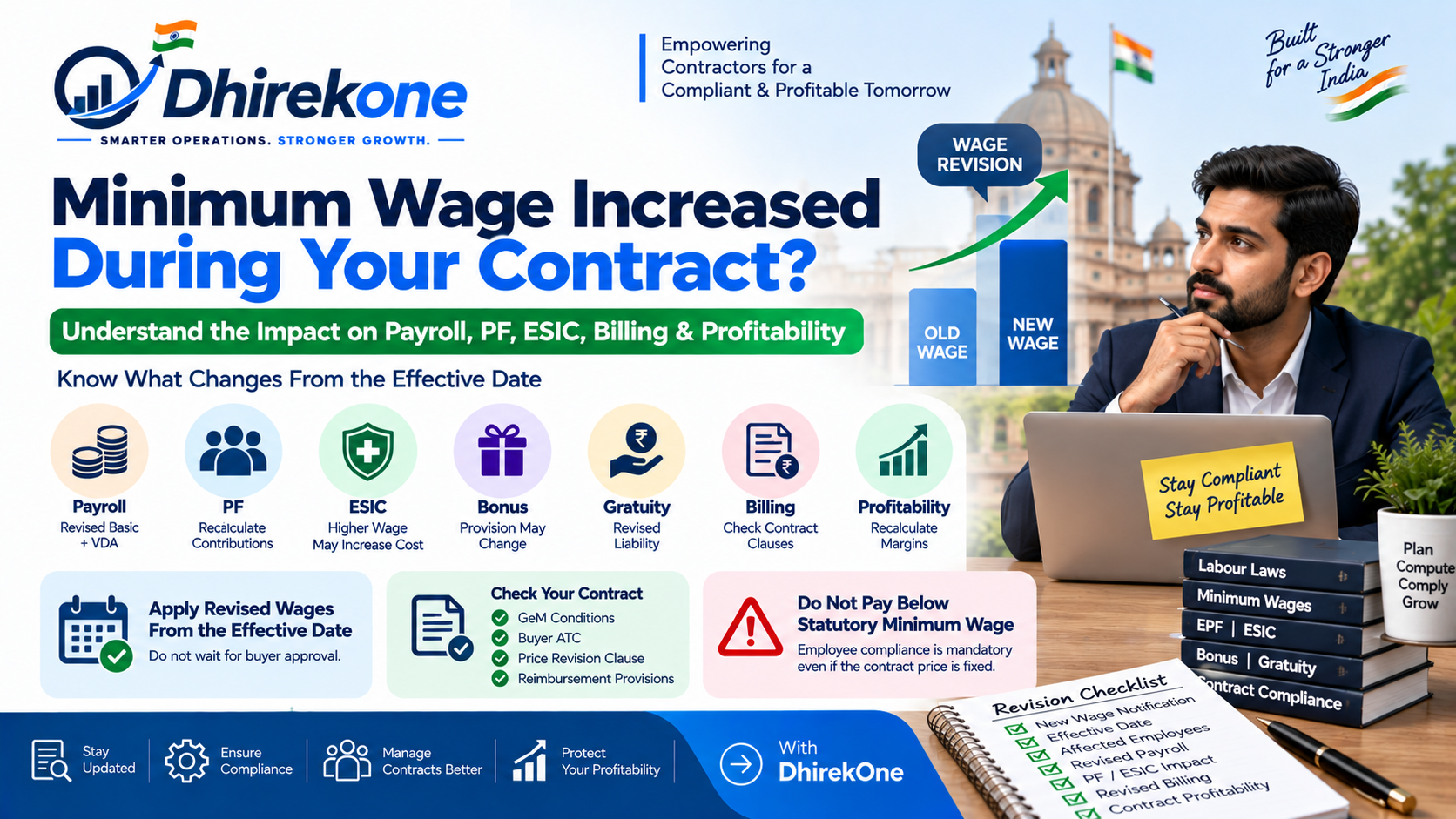
Minimum-wage revisions can materially change the economics of an ongoing manpower contract.
Suppose a contractor wins a 12-month tender using the minimum wage applicable on the bid date.
Six months later, the Government revises:
- Basic minimum wage
- Variable Dearness Allowance (VDA)
- Or both
From the effective date of the revised notification, the contractor cannot simply continue paying the old statutory minimum merely because the contract price was calculated earlier.
The contractor should immediately assess:
- Revised employee wage
- Revised payroll
- EPF impact
- ESIC impact
- Bonus and gratuity impact
- Billing eligibility
- Buyer reimbursement
- Service-charge impact
- Contract profitability
This guide explains the practical and legal effect of minimum-wage revisions on an existing manpower contract.
Does a New Minimum Wage Apply to an Existing Contract?
Yes, where the revised statutory minimum wage applies to the employees and establishment concerned.
A Government wage notification does not normally become irrelevant merely because the manpower contract was signed before the revision.
From the effective date of the revised rate, the contractor should ensure that eligible employees are paid at least the new applicable minimum wage.
The commercial question of whether the buyer reimburses the increase is separate from the contractor's wage-payment obligation.
Employee Wage Liability and Buyer Reimbursement Are Two Different Questions
There are two separate issues:
- What must the contractor pay the employee?
and
- What amount can the contractor recover from the buyer?
A contractor should not delay statutory wage revision merely because the buyer has not yet approved a revised invoice.
Employee compliance should be determined under applicable law.
Buyer reimbursement should be determined under the tender and contract conditions.
From Which Date Does the Revised Wage Apply?
Use the effective date stated in the wage notification.
Example:
Old wage applicable up to: 31 March 2026
Revised wage effective from: 1 April 2026
Then payroll from 1 April 2026 onward should reflect the new applicable wage.
Do not wait until:
- Buyer issues a separate letter
- Next invoice cycle
- Contract renewal
- Next financial year
unless the statutory notification itself provides otherwise.
How Often Can VDA Change?
For many Central-sphere wage categories, Variable Dearness Allowance is revised periodically based on changes in the Consumer Price Index.
The Chief Labour Commissioner maintains separate VDA revision orders, including revisions effective from April and October.
Therefore, a long-term manpower contract can experience more than one wage revision during its lifecycle.
Example: Wage Revision in the Middle of a Contract
Suppose:
Contract Start Date: 1 January 2026
Contract End Date: 31 December 2026
Old Applicable Wage: ₹18,000 per month
New Wage Effective: 1 April 2026
Revised Wage: ₹19,200 per month
Increase: ₹1,200 per employee per month
For 50 employees:
₹1,200 × 50 = ₹60,000 additional wage cost per month
For April to December:
₹60,000 × 9 months = ₹5,40,000 additional direct wage cost
This is before calculating the consequential effect on statutory contributions and employee benefits.
Does PF Cost Increase When Minimum Wage Increases?
Possibly.
Where EPF applies, a wage revision can affect the contribution base depending on:
- Employee's eligible PF wages
- Applicable statutory wage ceiling
- Existing salary structure
- Whether contributions are restricted to the statutory ceiling
- Contractual requirement for contribution on higher wages
Therefore, do not revise only the employee's gross wage.
Recalculate the EPF basis employee by employee.
Does ESIC Cost Increase After a Wage Revision?
It can.
Where the employee remains covered under ESIC, a wage increase can increase both:
- Employee ESIC contribution
- Employer ESIC contribution
because contributions are based on applicable wages.
A revision may also affect whether an employee crosses the statutory coverage threshold, subject to the contribution-period rules applicable under ESIC.
Therefore, ESIC should be re-resolved whenever the employee's wage structure changes.
Does Bonus Cost Change?
Potentially yes.
A wage revision can change:
- Employee remuneration
- Applicable bonus calculation base
- Annual bonus provision
- Tender costing
The exact effect depends on the employee's eligibility, applicable statutory framework and contract terms.
Contractors should therefore review bonus provision whenever wage structures are revised.
Does Gratuity Provision Change?
Yes, potentially.
If the statutory wage base used for gratuity increases, the contractor's gratuity exposure can also increase.
Therefore:
Old Wage Revision → New Salary Structure → Revised Gratuity Provision
should be part of contract-cost recalculation.
Do not treat gratuity as a fixed rupee amount throughout a long-term contract where the underlying wage base changes.
What Happens to Weekly-Off and Reliever Cost?
Reliever cost also increases when the applicable wage increases.
Example:
If a contract requires continuous deployment and additional relievers are employed for weekly offs, the revised wage applies to those employees as well.
Therefore a wage increase affects:
Regular Employees + Relievers + Replacement Employees
not merely the visible tender headcount.
Who Bears the Increase: Contractor or Buyer?
There is no universal answer that applies to every manpower contract.
The reimbursement position depends on the contract documents.
Check:
- GeM service conditions
- Bid document
- Scope of work
- Buyer Added Terms and Conditions
- Price escalation clause
- Statutory variation clause
- Minimum-wage reimbursement clause
- Contract amendment provisions
- Invoice structure
Some manpower contracts expressly provide for reimbursement of statutory wage revisions.
Others may place greater price risk on the service provider.
Never assume reimbursement without reading the contract.
Do Not Assume “Fixed Contract Price” Means You Can Pay the Old Wage
A fixed commercial contract price does not authorise payment below the statutory minimum wage.
If the applicable minimum wage rises:
Employee compliance obligation
and
Contract price adjustment entitlement
must be analysed separately.
A contractor may still need to pay the revised wage even while disputing or pursuing reimbursement from the buyer.
How to Check Whether the Buyer Must Reimburse the Increase
Search your contract for wording such as:
- Statutory variation
- Minimum wage revision
- Wage escalation
- VDA revision
- Government notification
- Reimbursement of statutory increase
- Price variation
- Differential wages
- Contract amendment
- Revision of manpower cost
Also inspect:
- GeM system-generated conditions
- Buyer ATC
- Service SLA
- BOQ / price schedule
- Corrigenda
What If the Tender Says Wages Will Be Revised as per Government Notification?
This generally strengthens the basis for revising employee wages and may support corresponding billing treatment, depending on the exact contract wording.
A practical process is:
- Obtain the official wage notification.
- Identify affected employees.
- Determine the old and new rates.
- Calculate the differential.
- Recalculate statutory contributions.
- Prepare a revised cost sheet.
- Notify the buyer in writing.
- Request contract / invoice amendment where required.
- Maintain employee-wise wage evidence.
What If the Contract Is Silent About Wage Revision?
If the contract does not clearly explain who bears a statutory wage increase:
Do not assume either:
“The buyer must definitely reimburse it”
or
“The contractor definitely has to absorb it.”
Instead:
- Comply with the revised statutory wage.
- Review the complete contract.
- Check GeM service-specific conditions.
- Check Buyer ATC and price schedule.
- Write to the buyer immediately.
- Request clarification / amendment.
- Maintain documentary evidence of the statutory revision.
- Obtain professional legal or contractual advice where the financial exposure is material.
Can the Contractor Recover the Difference Retrospectively?
It depends on:
- Effective date of the statutory revision
- Date the revised notification became enforceable
- Contract price-revision provisions
- Whether revised bills were submitted
- Buyer approval
- Contract amendment
- Limitation or claim conditions
If a notification operates from an earlier effective date than the date on which the contractor processes payroll, wage arrears may need to be calculated from the applicable effective date.
Contractors should therefore monitor wage notifications rather than relying only on buyer communication.
A Late Notification Can Create Wage Arrears
Example:
Notification published: 15 May
Revision effective: 1 April
If employees were paid the old rate for April, the contractor may need to calculate:
Revised April Wage
Already Paid April Wage
Wage Arrear
Any related statutory contribution impact should also be reviewed.
Does the Contractor Need to Revise Previous Payroll?
Where a wage revision applies retrospectively or from an earlier effective date, affected payroll periods may require adjustment.
A proper correction process should preserve:
- Original payroll
- Revised statutory basis
- Arrear calculation
- Employee-level differential
- Revised PF / ESIC treatment where applicable
- Payment proof
- Audit trail
Avoid silently overwriting historical payroll records.
How Should Arrears Be Calculated?
A simple wage-difference method is:
Revised Applicable Wage
Wage Already Paid
Wage Arrear
Then separately calculate any consequential statutory impact.
Example:
Revised Wage = ₹20,500
Already Paid = ₹19,600
Difference = ₹900
For 3 affected months:
₹900 × 3 = ₹2,700 wage arrear per employee
Then review:
- EPF
- ESIC
- Bonus basis
- Gratuity provision
- Overtime
- Other wage-linked benefits
What Happens to the Contractor's Service Charge?
That depends on how the tender defines the service charge.
If service charge is:
A percentage of wage-linked components
then a wage increase may increase the rupee value of the service charge.
If it is:
A fixed rupee amount
then the service charge may remain unchanged even while employment cost rises.
If the service charge is capped or fixed under the bid, the contractor's effective profit margin can shrink after a wage revision.
Always recalculate profitability.
Example: Profit Margin Before and After Wage Revision
Illustrative example:
Monthly Revenue Per Employee = ₹28,000
Original Total Cost = ₹26,000
Original Margin = ₹2,000
After wage revision:
Revised Total Cost = ₹27,400
If Buyer Revenue Remains = ₹28,000
New Margin = ₹600
Therefore:
Original Margin = ₹2,000
Revised Margin = ₹600
Margin Reduction = 70%
A relatively small statutory wage increase can materially reduce contract profitability.
What If the Contract Becomes Loss-Making?
A contractor should immediately calculate:
Revised Monthly Revenue
Revised Wage Cost
Revised Employer Contributions
Reliever Cost
Administrative Cost
Finance Cost
Other Contract Costs
=
Revised Contract Contribution
If the result becomes negative, the contractor should review:
- Price-revision entitlement
- Buyer correspondence
- Contract amendment
- Extension decision
- Additional deployment
- Service-charge structure
- Working-capital impact
Can a Contractor Stop Paying the Revision Until the Buyer Pays?
A statutory wage obligation should not ordinarily be made conditional on whether the buyer has reimbursed the contractor.
The contractor remains responsible for labour-law compliance toward its employees.
GeM bid conditions also place labour-law compliance obligations on service providers.
Does the Principal Employer Have Any Role?
Yes.
The principal employer has important labour-compliance interests in ensuring that workers deployed through contractors receive lawful wages.
Contract conditions may also require:
- Wage proof
- Bank transfer statements
- Attendance
- PF challans
- ESIC proof
- Wage register
- Salary sheets
Therefore, minimum-wage revisions can affect not only payroll but also monthly invoice documentation.
How Should a Contractor Notify the Buyer?
Send a written communication containing:
Subject: Revision of Minimum Wages / VDA w.e.f. [Effective Date]
Mention:
- GeM Contract Number
- Bid Number
- Contract period
- Work location
- Applicable Government
- Wage notification number
- Notification date
- Effective date
- Old wage
- Revised wage
- Difference
- Number of affected employees
- Revised statutory cost
- Revised monthly contract impact
- Request for approval / amendment / reimbursement
- Attach:
- 1. Official wage notification
- 2. Old vs revised wage comparison
- 3. Employee-category mapping
- 4. Revised cost sheet
- 5. PF impact
- 6. ESIC impact
- 7. Bonus / gratuity impact where relevant
- 8. Revised invoice calculation
- 9. Supporting tender clause
- 10. Request for contract amendment
What If Different Skill Categories Increase by Different Amounts?
Do not apply one average wage-increase percentage across the entire contract.
Calculate separately for:
- Unskilled
- Semi-Skilled
- Skilled
- Highly Skilled
- Clerical
- Supervisory
- Any special category
Then multiply the revised rate by the actual deployed headcount for each category.
What If the Contract Covers Multiple Zones or Sites?
A wage revision may not have the same financial impact at every site.
Calculate revision by:
Contract → Site → Appropriate Government → Zone → Skill Category → Old Wage → New Wage → Employee Count
Do not apply a single revised wage to employees working under different geographical classifications.
Correct Way to Handle Wage Revision
Minimum Wage Notification
↓
Identify Effective Date
↓
Identify Affected Contracts
↓
Identify Affected Sites
↓
Identify Affected Employees
↓
Resolve Skill Category & Zone
↓
Create Revised Salary Structure
↓
Calculate Wage Difference
↓
Recalculate PF / ESIC / Benefits
↓
Generate Arrears Where Required
↓
Update Payroll
↓
Update Billing
↓
Recalculate Contract Profitability
Should Historical Payroll Be Overwritten?
No.
Good payroll control should preserve historical evidence.
Instead of replacing the previous salary structure, maintain:
Revision 1 → Original Effective Period
Revision 2 → Revised Effective Period
Revision 3 → Next Applicable Revision
This creates an audit trail showing exactly which wage structure applied to each payroll month.
- When a new wage notification is issued:
- ✅ Check effective date
- ✅ Check appropriate Government
- ✅ Check employment category
- ✅ Check State / Central jurisdiction
- ✅ Check zone / area
- ✅ Check skill category
- ✅ Identify affected employees
- ✅ Compare old and new wage
- ✅ Revise salary structure
- ✅ Recalculate PF
- ✅ Recalculate ESIC
- ✅ Review bonus provision
- ✅ Review gratuity provision
- ✅ Review reliever cost
- ✅ Calculate arrears
- ✅ Pay wage differential
- ✅ Notify buyer
- ✅ Prepare revised cost sheet
- ✅ Request contract amendment where applicable
- ✅ Update invoice
- ✅ Track reimbursement
- ✅ Recalculate contract profitability
Common Mistakes After a Minimum Wage Revision
Common mistakes include:
- Continuing the old wage until contract renewal
- Waiting for buyer approval before revising employee wages
- Missing the effective date
- Updating Basic Wage but not VDA
- Updating regular employees but not relievers
- Not recalculating PF
- Not recalculating ESIC
- Ignoring gratuity impact
- Ignoring bonus impact
- Failing to calculate arrears
- Overwriting old payroll records
- Not informing the buyer
- Submitting revised invoice without evidence
- Assuming reimbursement is automatic
- Ignoring service-charge impact
- Ignoring contract profitability
- Missing a second wage revision during the same contract
Handle Minimum Wage Revisions Without Breaking Payroll History
Minimum-wage revisions affect more than one salary field.
A proper system needs to understand:
Contract → Site → Employee Classification → Wage Notification → Effective Date → Salary Revision → Attendance → Payroll → PF & ESIC → Arrears → Billing → Receivables → Profitability
DhirekOne is designed to help manpower contractors maintain effective-dated wage revisions instead of manually replacing salary values every time a wage notification changes.
This helps preserve historical payroll while applying the correct revised wage to future payroll periods and supports better contract-level costing and billing visibility.
Frequently Asked Questions About Minimum Wage Revisions
Q1. Does a revised minimum wage apply to an existing contract?Yes, where the revised statutory rate applies to the employees and establishment concerned. The contractor should apply the revised rate from its legally effective date.
### Q2. Can I continue paying the old minimum wage until the contract ends?

```markdown
No. An existing commercial contract does not generally authorise payment below the current statutory minimum wage.

Q3. From which date should the new wage be paid?
Use the effective date stated in the applicable wage notification.

Q4. Does VDA revision apply during an existing contract?
Yes, where the revised VDA notification applies to the employment. VDA changes should be incorporated from the effective date stated in the notification.

Q5. Will the Government buyer automatically reimburse the increase?
Not necessarily. Reimbursement depends on the specific tender, contract, GeM service conditions and price-variation clauses.

Q6. Does PF need to be recalculated after wage revision?
Potentially yes. Review the employee's revised PF wage base and the applicable contribution rules.

Q7. Does ESIC change after a minimum wage increase?
It can. Employer and employee contributions should be recalculated on the applicable ESIC wage basis where coverage continues.

Q8. Do I need to pay arrears if the notification has an earlier effective date?
If the statutory revision applies from an earlier effective date and the employee was paid below the revised applicable rate, the wage differential should be reviewed and arrears may be payable.

Q9. Can wage revision reduce my service-charge profit?
Yes. If the contract revenue or service charge does not rise proportionately, higher wage and statutory costs can reduce the contractor's effective margin.

Q10. Should I overwrite the employee's old salary structure?
No. Preserve the historical salary structure and create an effective-dated revision so that previous payroll periods remain auditable.

Q11. What documents should I send the buyer for wage revision?
Send the official notification, old-vs-new wage comparison, affected employee categories, revised statutory cost and the relevant contract clause supporting your request.

Q12. Can a wage revision make a contract loss-making?
Yes. If contract revenue remains fixed while statutory wage and related employment costs rise, the contractor's margin can shrink or become negative.
CONCLUSION
Conclusion
A minimum-wage revision can affect an existing manpower contract immediately from the effective date of the applicable statutory notification.
The contractor should not analyse only the difference in Basic Wage.
The complete impact can include:
Minimum Wage → VDA → PF → ESIC → Bonus → Gratuity → Reliever Cost → Payroll → Billing → Service Charge → Contract Profitability
The first obligation is to ensure that employees receive at least the legally applicable wage.
The second question is whether the additional contract cost can be recovered from the buyer.
That answer depends on the tender and contract terms.
Therefore, every manpower contractor should monitor wage notifications throughout the contract period, maintain effective-dated salary revisions, promptly calculate arrears where required and notify the buyer with documentary evidence.
DhirekOne helps contractors connect wage revisions with salary structures, payroll, statutory compliance, billing and contract profitability without destroying historical payroll evidence.