
How to Track Government Buyer Payments and Outstanding Bills?
Government contractors should track every invoice from submission to final payment. A simple receivables system helps identify pending bills, partial payments, overdue amounts and buyer follow-ups before cash-flow problems grow.
In this article
ARTICLE CONTENT
How to Track Government Buyer Payments and Outstanding Bills?
Do not track payments only through bank statements or WhatsApp messages.
Every invoice should have a clear payment status.
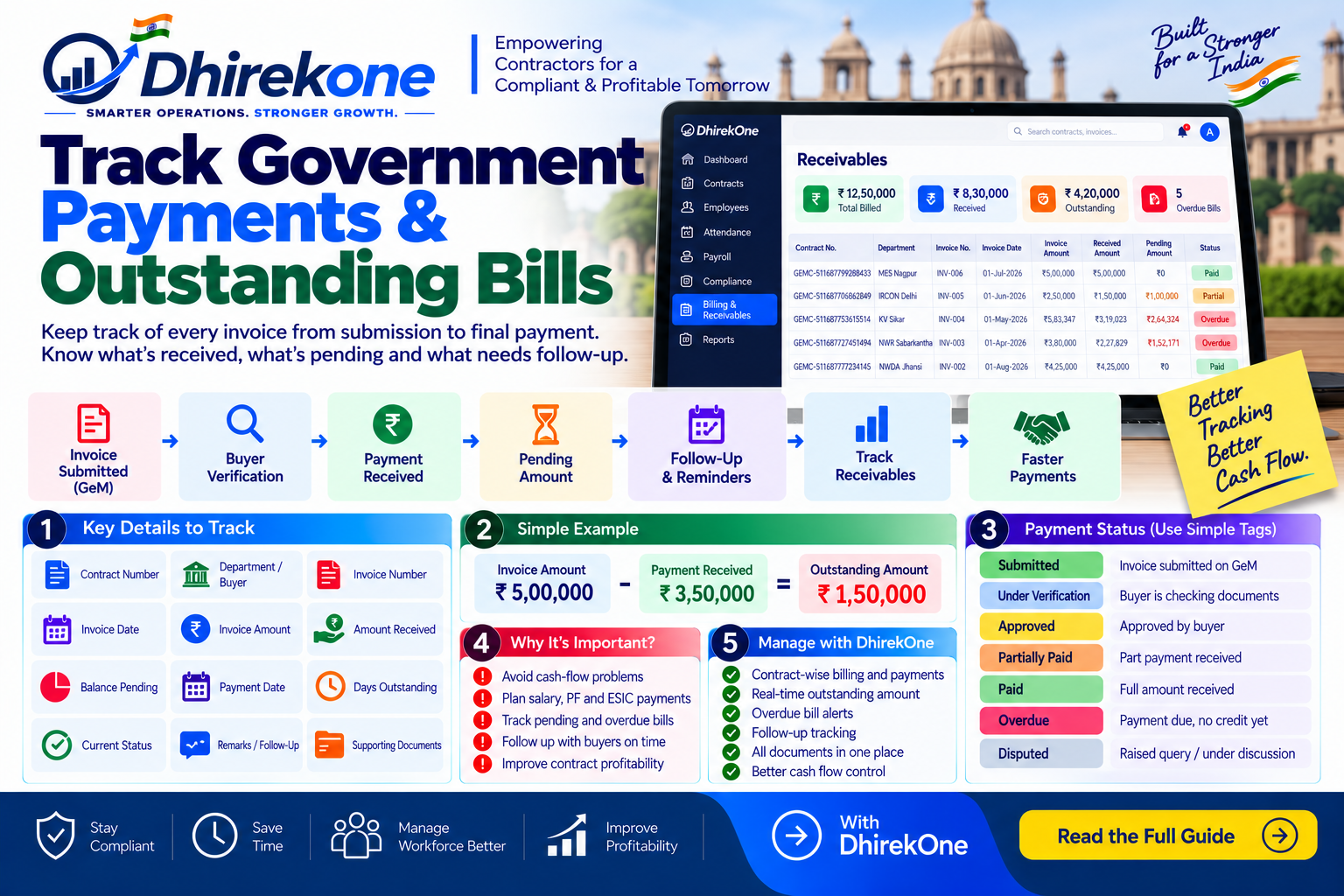
Track These Details
For each bill, record:
- Contract Number
- Buyer / Department
- Invoice Number
- Invoice Date
- Invoice Amount
- Amount Received
- Balance Pending
- Payment Date
- Days Outstanding
- Current Status
Simple Formula
Invoice Amount
Amount Received
Outstanding Amount
Example
Invoice Amount: ₹5,00,000
Payment Received: ₹3,50,000
Outstanding:
₹5,00,000 - ₹3,50,000 = ₹1,50,000
Useful Payment Status
Use simple statuses such as:
- Submitted
- Under Verification
- Approved
- Partially Paid
- Paid
- Overdue
- Disputed
Why Is This Important?
Untracked receivables can cause:
- Salary cash-flow pressure
- PF / ESIC payment stress
- GST funding issues
- Working-capital problems
- Missed follow-ups
- Lower contract profitability
Best Practice
Track payments contract-wise:
Contract → Invoice → Buyer Verification → Amount Received → Outstanding → Follow-Up → Closure
Conclusion
A contractor should always know:
How much was billed, how much was received, and how much is still pending.
DhirekOne helps contractors track billing, payments, outstanding amounts and receivables contract-wise from one dashboard.