
How to Calculate Salary Arrears After Minimum Wage Revision?
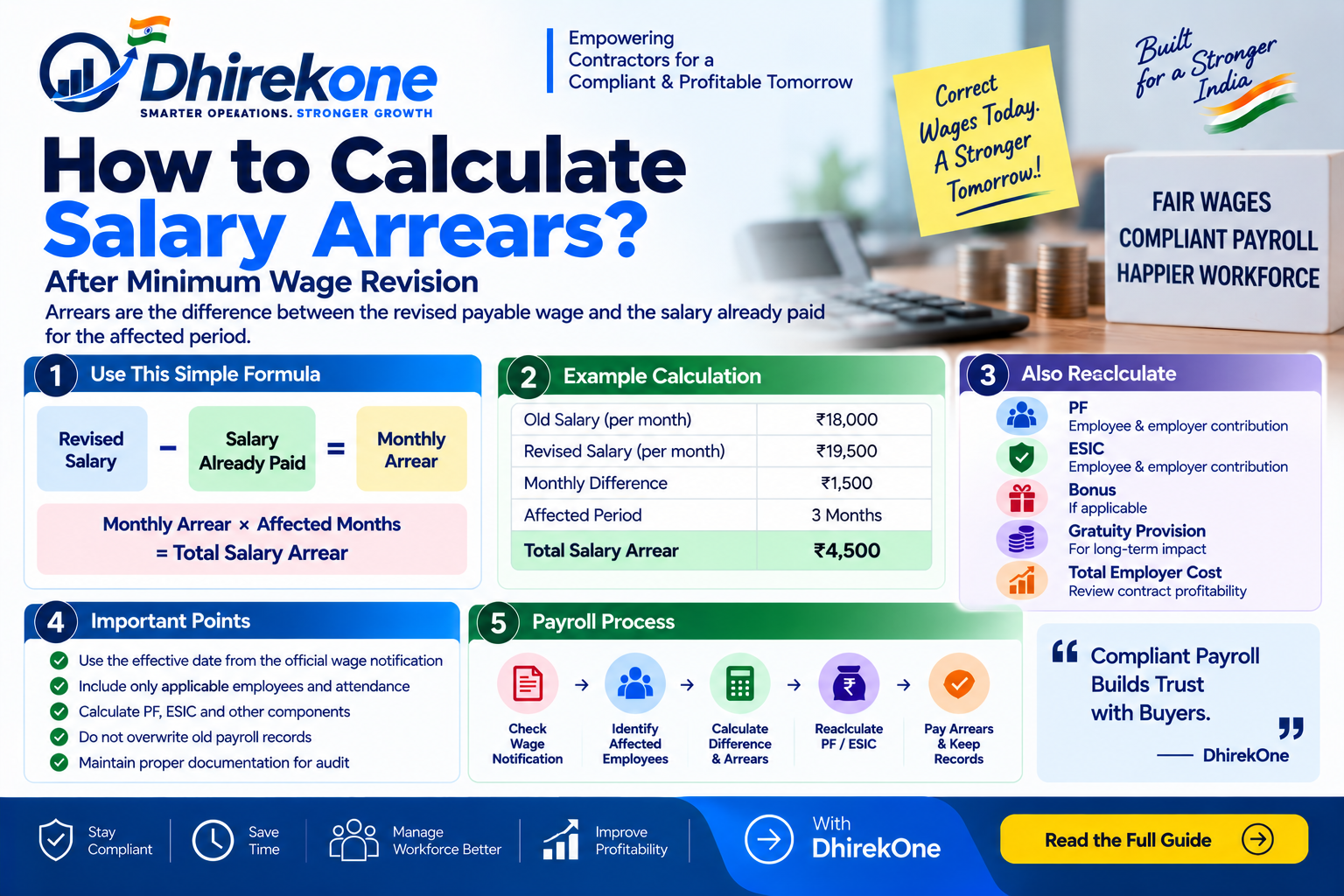
When minimum wages or VDA are revised from an earlier effective date, employees may become eligible for salary arrears. Arrears are the difference between the revised payable wage and the salary already paid for the affected period.
In this article
ARTICLE CONTENT
How to Calculate Salary Arrears After Minimum Wage Revision?
Salary arrears arise when a revised wage becomes effective from an earlier date, but the employee was already paid using the old wage.
Simple formula:
Revised Salary
Salary Already Paid
Monthly Arrear
Then:
Monthly Arrear × Affected Months
Total Salary Arrear
Example
Old Salary: ₹18,000
Revised Salary: ₹19,500
Monthly Difference:
₹19,500 - ₹18,000 = ₹1,500
Affected Period: 3 Months
Total Arrear:
₹1,500 × 3 = ₹4,500
The employee is therefore entitled to ₹4,500 salary arrear, subject to attendance and applicable payroll rules.
What Else Should Be Recalculated?
A salary arrear may also affect:
- PF
- ESIC
- Bonus
- Gratuity provision
- Employer cost
Do not calculate only the salary difference.
Important
Always use the effective date mentioned in the official wage notification.
Example:
Revision effective: 1 April
Revision processed: June
Then April and May payroll should also be reviewed.
Correct Payroll Process
New Wage Notification → Identify Effective Date → Find Affected Employees → Calculate Wage Difference → Recalculate PF / ESIC → Pay Arrears → Preserve Old Payroll Records
Do Not Overwrite Old Payroll
Keep the original payroll as historical evidence.
Use:
Original Payroll + Arrear Adjustment + Revision Evidence
This creates a clear audit trail.
Conclusion
Salary arrears are simply the difference between the revised payable wage and the amount already paid for the affected period.
Whenever arrears are calculated, also review PF, ESIC and other wage-linked statutory components.
DhirekOne helps contractors connect wage revisions, arrears, payroll and compliance in one workflow.