
How Should Payroll Preserve Historical Salary Revisions?
Payroll should never overwrite an employee’s old salary when a new salary revision is created. Each revision should be stored with its own effective date so that past payroll uses the old salary and future payroll uses the revised salary. This creates a clean audit trail and prevents payroll, PF, ESIC and arrear mismatches.
In this article
ARTICLE CONTENT
How Should Payroll Preserve Historical Salary Revisions?
When an employee's salary changes, the old salary should not be deleted or replaced.
Instead, payroll should maintain separate salary revisions with clear effective dates.
Example:
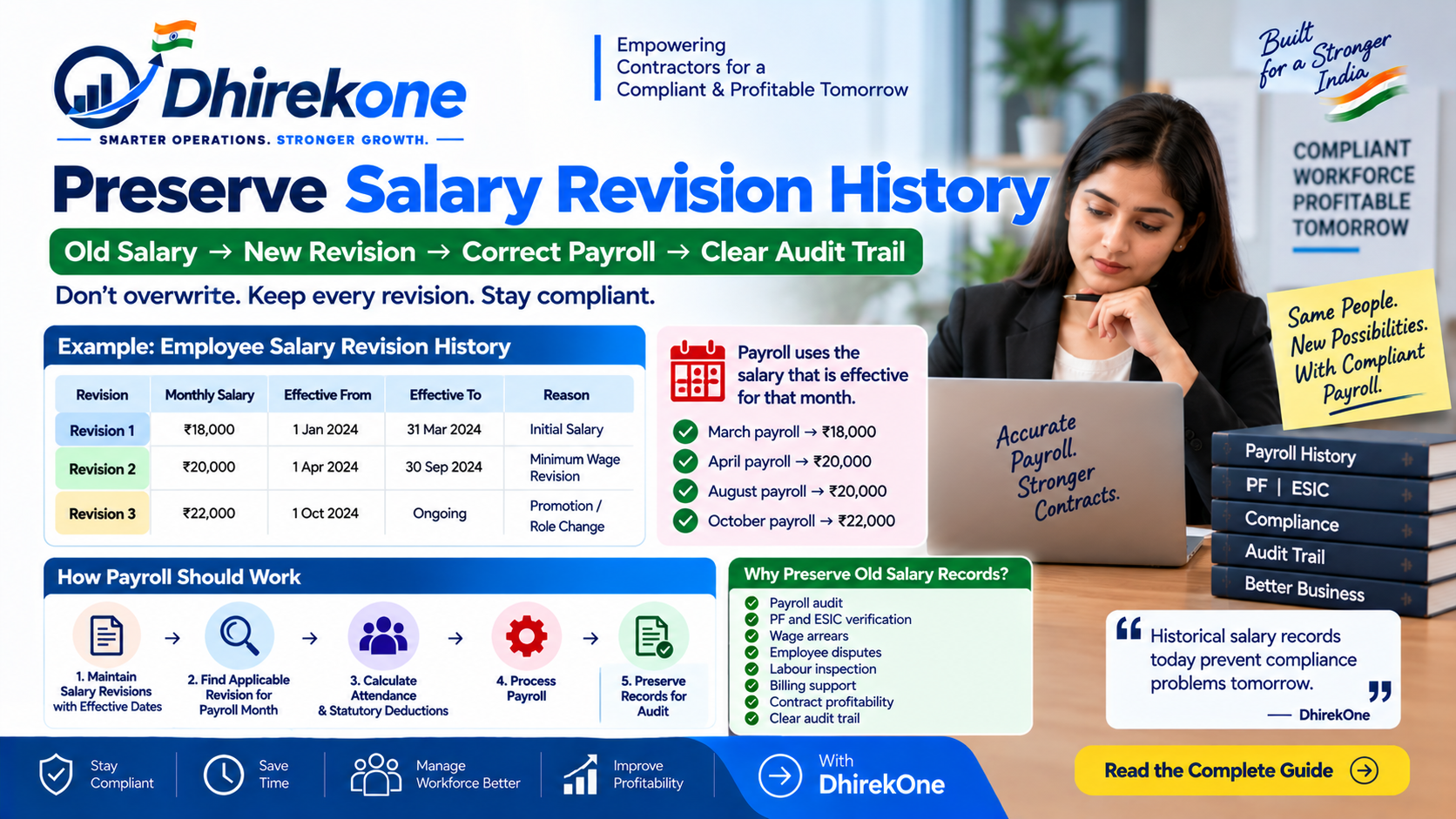
Revision 1 ₹18,000 Effective: 1 January to 31 March
Revision 2 ₹20,000 Effective: 1 April to 30 September
Revision 3 ₹22,000 Effective: 1 October onward
This allows payroll to know exactly which salary applied in each month.
Why Should Old Salary Records Be Preserved?
Historical salary records are important for:
- Payroll audit
- PF and ESIC verification
- Wage arrears
- Employee disputes
- Labour inspection
- Billing support
- Contract profitability
- Salary revision evidence
If old salary values are overwritten, it becomes difficult to explain why a previous payroll was calculated differently.
Correct Payroll Rule
Payroll Month → Find the salary revision effective for that month → Use that revision → Calculate attendance and statutory deductions → Finalise payroll
Example:
March Payroll → Revision 1
April Payroll → Revision 2
October Payroll → Revision 3
The latest salary should never automatically be used for every historical month.
What If Salary Revision Is Entered Late?
Suppose:
New salary effective: 1 April
Revision entered: June
Do not change the effective date to June.
Instead:
- Create the revision effective from 1 April.
- Preserve April and May original payroll.
- Calculate salary difference.
- Calculate PF / ESIC difference where applicable.
- Pay arrears.
- Maintain adjustment evidence.
This keeps the payroll history accurate.
Do Not Overwrite Finalised Payroll
Finalised payroll should remain unchanged as historical evidence.
If a correction is required, use:
Original Payroll + Correction / Arrear + Revision Evidence
instead of silently modifying the old payroll.
What Should Each Salary Revision Store?
A good salary revision record should contain:
- Employee
- Salary amount
- Salary components
- Effective-from date
- Effective-to date
- Revision reason
- Minimum wage reference, where applicable
- Contract / site
- Skill category
- Zone
- Created by
- Approved by
- Timestamp
Simple Example
Employee Salary:
January–March: ₹18,000
April Revision: ₹20,000
October Revision: ₹22,000
When checking August payroll later, the system should still use ₹20,000.
It should not use ₹22,000 simply because ₹22,000 is the employee's current salary.
Best Practice
Use:
Effective-Dated Salary Revisions
not:
Editable Current Salary Only
The ideal payroll structure is:
Employee → Salary Revision History → Applicable Revision → Attendance → Payroll → PF / ESIC → Arrears → Audit Trail
Conclusion
Payroll should preserve every historical salary revision.
Never overwrite old salary records.
Each revision should have its own effective period so that:
- past payroll remains correct,
- future payroll uses the new salary,
- arrears can be calculated properly,
- PF and ESIC remain traceable,
- and audit history stays intact.
DhirekOne is designed around effective-dated salary revisions so payroll can resolve the correct salary for each payroll month without destroying historical evidence.